|
|
|
|
|
|
Overnight we sailed up to Deception Island and waited outside the entrance to this volcanic caldera in the mist and drizzle before entering through "Neptune's Bellows" then taking a sharp right turn into Whalers Bay - the first possible landing area on Deception Island.
Whalers Bay
As we begin landing zodiacs on the beach the mist and drizzle stops and the
sun begins to peep through the gaps. The beach is long with ruins scattered
along its length, relics of the former whaling station. To the left the station
itself with some remaining buildings including a hanger and a left over plane.
To the right an expanse of beach leading up to a break in the caldera wall known
as Neptune's Window and containing nesting sites of Cape Petrels.
|
|
|
|
|
|
The beach also has basking fur seals and Weddell seals, and we have to be careful that we don't get too near to them - they can be aggressive when they feel threatened.
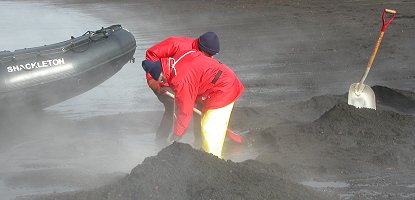
The other main feature of Deception Island is the presence of recent volcanic
activity and therefore the hot sands that can be uncovered. Dig down a bit, make
a border/wall, fill it water and wait - you then get a hot tub - a jacuzzi
without the bubbles - though it is possible to create bubbles but it is
considered socially unacceptable.
|
|
|
|
|
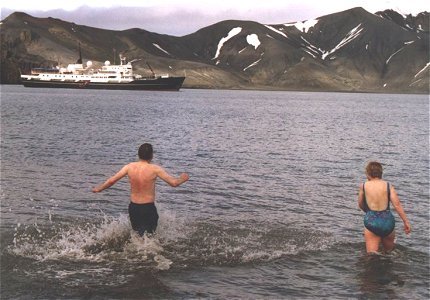
The experience was quite invigorating. It has to be said, although the sea temperature was about 1 deg, the air temperature was about 5 deg, so all-in-all probably not a lot worse than Scarborough in mid-summer. Suitably refreshed, we returned to the boat for lunch. As we boarded the ship the mist closed in again and the clouds returned.
Hannah Point
Our last landing in Antarctica. A beach and landing area full of Gentoo and Chinstrap penguins (with just a couple, literally, of Macaroni penguins). Along the beach area there was also an elephant seal "harem". The penguin chicks were very inquisitive and had a good look about the visitors almost without fear - which, of course, they did have nothing to fear.
|
|
|
|
The stripy bits on the floor on the above picture is penguin poo, which is "ejected" with great force and first hits the ground about 18 inches away from the penguin. Because the penguin nests are piles of stones they don't like to mess them up with unpleasantness, so being able to eject well clear is quite useful.
Further along the beach were fossils showing leaf impressions. These fossils were on a table about a mile away from the penguin rookery. Had they been in situ you could understand why there was a mile walk along the beach, however, they weren't, so why someone couldn't have just brought the table a bit closer and saved a bit of leg work I do not know.
Despite starting quite fine, the weather began to close in and we left the island about half an hour early to avoid the snow which had already begun to fall. Val got the last zodiac back (almost missed it, actually) as she ran off to view a Macaroni penguin which had turned up!
Back on the boat and it is time to eat again.
Continue to Elephant Island
Return to contents