|
|
|
Salisbury Plain
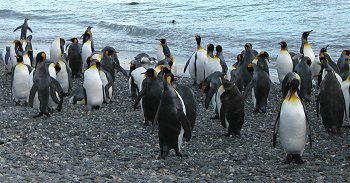
This location has quite a large colony of King Penguins, many of which like to go for a swim before dawn. It is because of this that we have a 3.15am alarm call. Tea and biscuits were served in the restaurant prior to departure (thank goodness!).
On the beach there were plenty of King Penguins in and out of the water as well as the now ubiquitous seal pups.
|
|
|
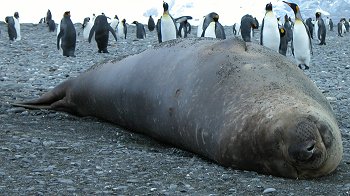
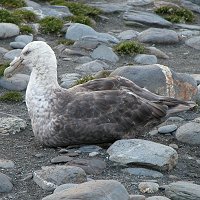
Further down the beach we encountered a very large elephant seal having a sleep (obviously not an early riser!), and further along still there was a variety of Antarctic birds. Intermingling with all of these were king penguin chicks, once thought to be a species of it own and named "Woolly penguin". By the banks of a stream, which flowed into the sea, stood more King penguins and most spectacular of all was the rookery itself, which seemed to stretch hundreds of yards in all directions, then up the hill where the white bits were front of penguins and the grey bits the back. There must have been well over 100,000 penguins here.
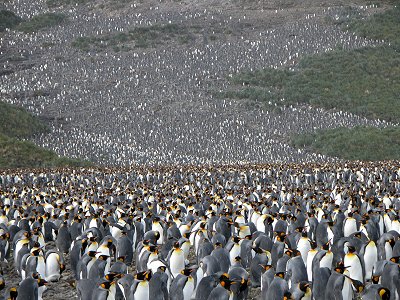
A small fraction of the penguin rookery
|
|
|
|
|
|
|
The sunrise wasn't much, but it didn't seem to matter having seen the fantastic colony of Kings. On our way back to the beach for the zodiac, we encountered a second elephant seal on the move, heaving its large mass up the beach and into a muddy river. The sight and sounds were incredible, and the smell was disgusting. Having got the last zodiac back at 6.30am for breakfast, we were back on the beach with the late risers at 8.15am for more of the same. Some extra bits seen were a petrel chick and some of the rarer white fur seals. We also observed the friendliness of the penguin chicks.
|
|
|
|
The rest of the time was spent just sitting on the beach watching the penguins and seal pups play in and out of the water and letting the larger King Penguins approach us - no doubt investigating the wildlife that turns up regularly on the beach. To them we are clearly parasitic as we arrive on the back of a large black water born creature - the "rigidus inflatable zodiacus". Sadly, time to leave as we board the last zodiac back at 11.00 and get back in time for lunch.
Prion Island
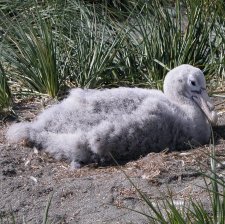
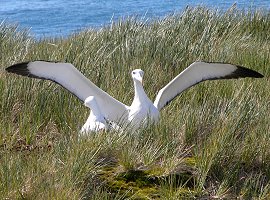
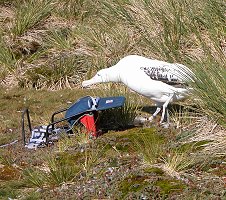
Prion Island is spitting distance from Salisbury Plain in the Bay of Isles and has a Wandering Albatross colony. The colony is small and so are the groups that go to see them, so this time the landings are timed. To reach the colony requires a bit of an uphill walk through an almost just recognisable track, which was a bit wet with some deep wet bits (that looked like they weren't). It was worth the effort as at the top there were a number of nesting Wandering Albatrosses. Some were just sitting around, others were displaying to their partner and occasionally one would fly in. One on these incomers overshot the site and had to walk back up the path to get to his nesting place - passing a child's carry-cot backpack which provided us with an idea of size.
|
|
|
|
Back at the foot of the hill - an equally precarious walk down, we delayed our return so that we could look for the South Georgia pipit bird. After a while we saw one well, actually, we saw three. We spent the rest of the time, 'till the last zodiac, watching the playful seal pups, the Antarctic terns diving for food, and any other birds that fancied to fly over. As we returned to the boat one of the zodiacs shot off to pick up some more scientists from Albatross Island, also to transport them to the Falklands.
Meanwhile, we had dinner.
Continue to Stanley
Return to contents