The reason we chose Alaska in March was to go and see the Aurora Borealis, or Northern Lights. Like any natural phenomena, such as the aurora or even a solar eclipse, you can't guarantee that you will see it, all you can do is give yourself the best chance. The aurora is produced by the particles ejected from the sun spiralling down the Earth's magnetic field lines and exciting the oxygen and nitrogen atoms in the atmosphere to give off a variety of coloured "lights" in the sky - and hence exciting all the people on earth watching them. The orientation of the Earth at the Spring Equinox (20 March) increases the chances of the solar wind particles entering the Earth's magnetic field, add to this the increased sunspot activity as the Sun approaches "Solar maximum" and things are looking pretty good. All this usually takes place in an band, called the auroral oval, around the geomagnetic North Pole - where your compass points to and located in the far North-East of Canada (79N, 105W). Picking a time close to a New Moon means that there is no Moon in the sky to add extra glow to obscure the relatively faint aurora. So, here we are, in Alaska in early March, "freezing our butts off" as the locals might say.
The story begins in Anchorage airport waiting for our fellow travellers to arrive, but the time passed quickly as most of it was spent filling in the form reporting lost luggage, which never made it onto the plane in Amsterdam.
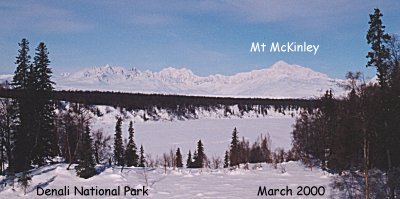
After a day to take in the local sights (during which time the luggage caught up with us), we hit the road to go 300 miles further North, to increase our chances of aurora spotting even more. The bus drove through Denali National Park and gave a wonderful view of the Alaska Range and in particular Mt McKinley (America's highest mountain at 20,320ft above sea level) - a sight not often available. To quote one guide: "Mt. McKinley is a flirt hiding in the clouds - count yourself lucky to get a clear day because they are rare and precious".
Overnight was spent at Healy, and at about 8.45pm John Mason, the group's professional astronomer, announced in the restaurant that an auroral arc was forming. The room would not have emptied quicker if he had shouted "fire".
Over the next 2 hours the sky became alive with curtains of green light, slowly forming and moving across the sky. With the prospects of the "show" continuing, it's difficult to decide when to stop watching. Fatigue from the recent flight won, though, and it was bedtime at 12.30am.
The north facing room was advantageous because at 4.00am looking out the sky could be seen pulsating with the green light of the aurora.

The next day's travelling took us to Fairbanks then on to Chena Hot Springs Resort, located at a latitude of 65 degrees North and only about 60 miles short of the Arctic Circle, home for the next four aurora watching nights.
The days were spent exploring the trails around the resort, sticking to the packed snow routes because veering off from them without snow shoes would result in sinking into 4 or 5 ft of powdered snow. Other pastimes included dog sledding and soaking weary limbs in the warm waters of the hot springs, though the 25yd walk back, half naked and wet in temperatures of -10C doesn't feature very high on my list of "must do more often".
Each evening the aurora was observed with varying degrees of brightness and activity. Again, knowing when to stop watching and go in varied between 2.00am and 3.30am, but was often dependent on how much the night temperatures of about -20C (without wind chill) was getting to us.
A variety of lenses were used to photograph the aurora and some of the results are presented here:
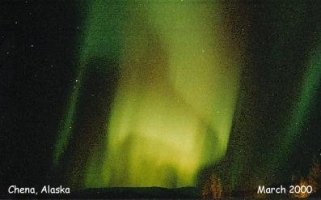 55mm f1.8 lens | 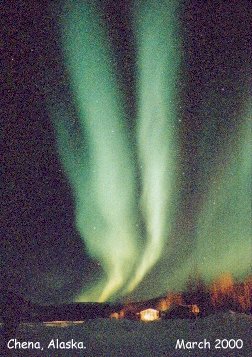 18mm f4 lens |
 35mm f2.8 lens |
All exposures were a counted 30 seconds - if the aurora was bright, I counted quickly, if very faint (or using a "slow" lens) I counted slowly and added one or two for luck - very scientific!
Unfortunately the time in Alaska was over all too soon and we had to force ourselves away to the second half of the holiday in Hawaii. We left Anchorage with a temperature 28F (-2C) and arrived in Hawaii at 82F (28C), but that's a different story.
Postscript:
Having spent mega-bucks going to Alaska for the aurora we observed a fantastic display from the back garden in Culcheth on 6 April 2000 - showers of green and bright-red sheets and streamers of light in the sky in plus temperatures, too.